Backend
Java · Spring Boot · Spring MVC · REST · Spring Security · JPA/Hibernate · Maven
I'm Pothuraju Vyshrawan, a final year CSBS student at VIT-AP focused on backend engineering, distributed systems and AI integrated applications.
My work sits at the intersection of reliable backend systems and practical AI. I build APIs, event driven services and distributed workflows, then connect them to retrieval, agents and LLM powered features where they genuinely add value.
Java · Spring Boot · Spring MVC · REST · Spring Security · JPA/Hibernate · Maven
Kafka · Redis · Microservices · SAGA · CQRS · Transactional Outbox · SSE
LangChain · LangGraph · RAG · Spring AI · prompt engineering · vector retrieval
Docker · GitHub Actions · AWS EC2 fundamentals · IaC basics · PostgreSQL · ChromaDB
JWT · OWASP Top 10 · input validation · sanitization · secure coding · rate limiting
JUnit · Mockito · JMeter · Postman · API testing · performance oriented thinking
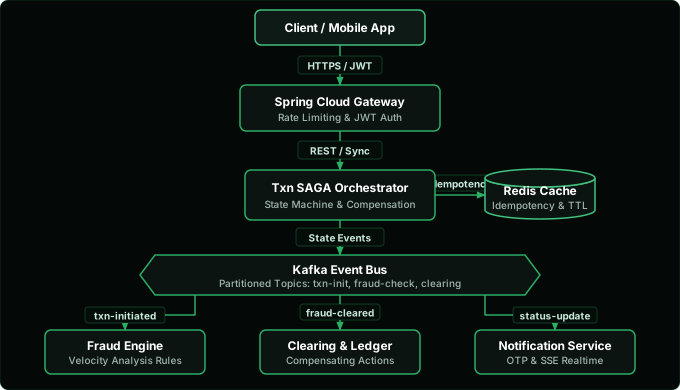
Six service Spring Boot architecture with Kafka, Redis and Docker. Uses SAGA orchestration with compensating actions, fraud velocity analysis, OTP step up verification and API gateway rate limiting.
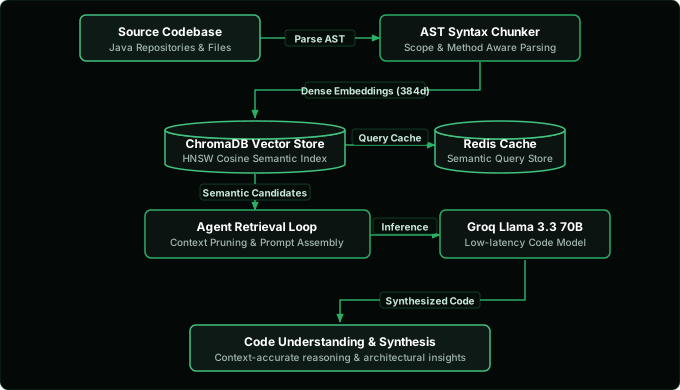
Java native agentic RAG system for code understanding. Built the chunking, embedding and semantic retrieval pipeline from scratch with ChromaDB and Groq Llama 3.3 70B.
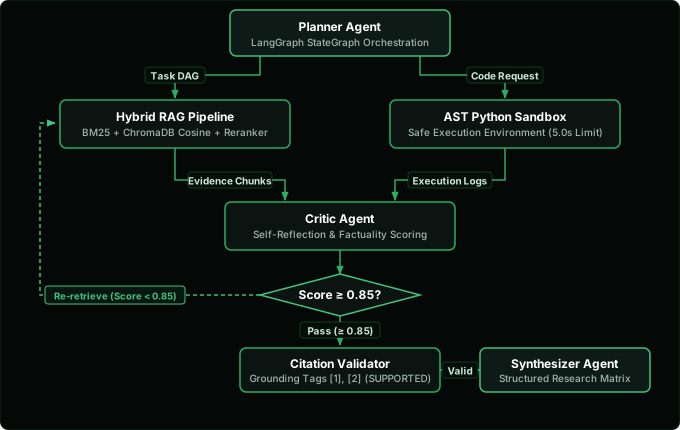
Autonomous research and reasoning platform built with LangGraph StateGraph orchestration. Features hybrid BM25 + ChromaDB dense vector retrieval, an AST inspected Python execution sandbox, and self reflection critic loops with verifiable citation grounding.
An honest, transparent map of how much AI knowledge I have: distinguishing between systems I actively build hands on (agents, RAG pipelines, evaluations) versus foundational concepts I understand without pretending to have enterprise work experience.
LangChain tool calling, agent loops, LangGraph state machines, routing, retries, and human in the loop patterns.
Chunking strategies, dense & hybrid vector search, retrieval quality, semantic reranking, context caching, and ChromaDB.
Conceptual understanding of PEFT, LoRA and QLoRA, parameter efficiency and quantization trade offs, knowing when fine tuning is needed instead of RAG.
Evaluating task success, faithfulness, context recall, latency, cost, and regression testing rather than subjective "looks good" checks.
Few shot calibration, structured JSON outputs, deterministic decomposition, and explicit chain of thought for reliable execution.
Understanding production engineering trade offs: token budgets, latency SLAs, streaming responses, timeouts, rate limits, and fallback strategies.
Even though I have not operated enterprise clusters in a full time corporate role yet, I do not build toy demos. I study and build around real engineering fundamentals by designing every service with failure modes, concurrency, latency, and data integrity in mind.
Understanding that profiling real latency, throughput, error rates, and memory usage beats intuition and guesswork.
Knowing distributed networks fail: applying timeouts, exponential backoffs, idempotent consumers, and SAGA compensations.
Recognizing that auth, least privilege tokens, input sanitization, secret hygiene, and rate limits belong in the initial design.
Treating code and AI pipelines with equal rigor: metrics, structured logs, evaluation benchmarks, and deterministic fallbacks.
I'm open to software engineering, backend and AI engineering opportunities.